Watchmaking education
Design meets engineering
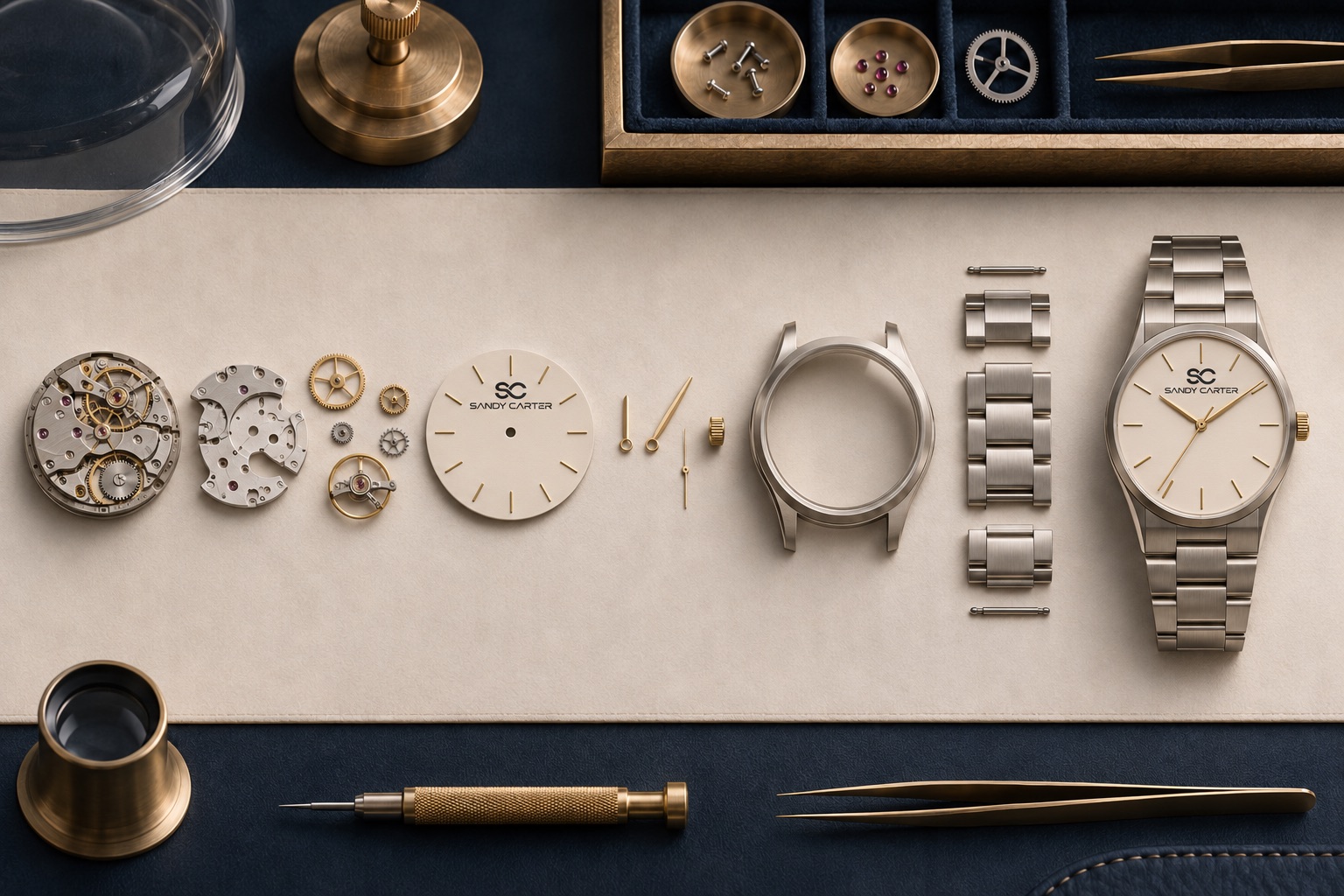
A watch brings together a movement, a case, a dial and a strap. Each part has to work with the others.
TIME REFINED
Small components, shared purpose
The movement determines practical requirements for the hands and dial. The case protects the assembly and provides attachment points. Good design considers these relationships from the beginning.
Know what you are buying
A visual style does not tell you where a movement was made or how a watch was assembled. Use confirmed product specifications for those details rather than relying on general brand language.
A watch is experienced as one object, yet its character emerges from many connected decisions. The dial communicates, the case protects and frames, the movement keeps time, and the strap or bracelet determines how the object meets the wrist. Thoughtful watch design considers these elements together.
The dial as information architecture
A dial must make time readable before it can become expressive. Hands, hour markers, numerals and any additional display need a clear hierarchy. Negative space is not unused area; it separates information and gives the eye a path through the composition.
Typography can add character, but scale and spacing remain essential. A logo, minute track or date window should feel integrated rather than placed after the design is complete. The official SANDY D. CARTER identity is shown only where it can be reproduced accurately.
Case, bezel and crown
The case gives a watch its three-dimensional silhouette. Diameter is only one measure. Thickness, lug-to-lug length, bezel width and crown proportion change both appearance and fit. The case should relate to the dial opening and the intended wearing experience.
Surface finishing also changes perception. Brushed areas soften reflections; polished areas create sharper highlights. Neither is inherently more premium. Quality is revealed through consistency, appropriate transitions and a finish that supports the design intent.
The movement within
The movement is the mechanism that measures and displays time. Quartz, mechanical hand-wound and automatic movements achieve this differently. Each approach has its own practical qualities, maintenance expectations and emotional appeal. No one category automatically guarantees a better watch.
SANDY D. CARTER has not announced movements for its first collection. Exact calibre type, origin, accuracy guidance and service information will be stated model by model after verification.
Materials and the wearing experience
Case material, crystal, strap and bracelet construction influence weight, comfort, durability and appearance. These are product facts, not details to infer from conceptual imagery. Approved pages will identify materials clearly when the collection is ready.
Comfort depends on the complete geometry: the curve of the lugs, case-back profile, bracelet articulation and strap flexibility. A coherent watch balances visual proportion with the practical reality of being worn for hours.
From concept to approved product
Research and sketches establish intent. Technical drawings test dimensions and relationships. Prototypes make scale, legibility and surface transitions tangible. Refinement continues until design and verified production information can be presented together.
The imagery here is educational and conceptual. It does not document a SANDY D. CARTER factory or announce a finished product. The actual collection remains empty until the official reveal.